
The Leica R6 was an entirely mechanical manual exposure SLR. Produced during the age of electronic camera dominance, the R6 was a pretty unique camera.
The year is 1988. Camera manufacturers are working hard to outdo each other.
Nikon has just introduced the first digital camera in the world. Other camera manufacturers are working on improving their electronic cameras.
Leica decides to take a different approach.
Rather than adding extra electronic features in their new flagship, Leitz reduced the number of electronics to a bare minimum.
Here are some of the features that made it so unique.
Features of the Camera
The most prominent feature of the R6 was the return to the Leica manual minimalistic style of building cameras.
Electronics were reduced to a minimum.
The R6 also came with a mechanically timed vertical travel shutter. But this shift to a mechanical shutter came at a price.
With the R6, you could only achieve a maximum shutter speed of 1/1000 sec. However, a later version of the R6, the R6.2, came with an improved shutter speed OF 1/2000 sec.
The introduction of these mechanical features meant that the camera could function without batteries. No more worrying about batteries when on long shoots.
If you’re someone who loves extreme outdoor photography, you’re bound to love the R6.
Another feature that made the R6 such a great camera, was its big bright and uncluttered viewfinder.
At a time when most cameras had a cluttered viewfinder, thanks to numerous controls, the R6 finder didn’t have much to display. With the R6, you can focus fully on your composition without distracting words and LED lights on the viewfinder.
And that’s not all!
Despite having a non-changeable viewfinder, the R6 came with a choice of five interchangeable viewscreens. These are:
- The standard viewscreen that had a course-central micro prism area with a central split-image focusing aid.
- The Plain ground glass screen for long focal length cameras and extreme close-ups
- Micro prism screen
- The Full-field ground glass screen for architecture photography.
- The clear glass focusing screen for astrophotography and other scientific photography.
Despite lacking fancy electronics, the R6 is a pretty versatile camera.
Another feature that made the R6 a remarkable camera was the ability to lock up the mirror—a feature that wasn’t there in the R5.
Despite having a manual exposure system, you can reduce vibration-induced motion blur, thanks to the mirror lock-up system.
Were there any electronic parts in the R6?
Yes!
Both the centre-weighted and spot metering couldn’t work without batteries.
The R6 also came with an electronic self-timer.
Design and Physical Build
Like it’s predecessors, the R4 and R5, the R6’s craftmanship screamed Leitz and Minolta.
The camera was exquisitely designed and features a simplistic minimalistic look.
Thanks to the well-designed controls, the top plate isn’t congested.
When holding the camera, every knob, dial, or lever feels naturally in place and are just the right size.
And that’s not all!
The camera also feels quite sturdy and solid. Coupled with the fact that it’s fully mechanical, the R6 can function in any environment.
Neither heat nor cold can stop the R6.
Versions of the R6
In 1992, Leitz released the Leica R6.2.
The R6.2 came with an improved maximum shutter speed as well as a magnified exposure counter.
Both the R6 and R6.2 came in chrome and black finishes.
Shortcomings of the Camera
Manufacturing a mechanical camera when everyone was producing electronic camera was expensive.
Leitz transferred this cost to the consumer.
Thanks to this, the R6 was out of reach to many photographers. Only wealthy Leica enthusiasts bought the camera.
The R6 also didn’t come with an on/off switch. The lack of this feature meant that the shutter could be triggered accidentally.
Final Thoughts
Few companies are willing to challenge the status quo.
To stick to their true values despite mounting pressure to change.
Leitz did this with the R6.
Rather than succumbing to change, Leitz stuck to their values and delivered a well built, mechanical SLR capable of taking excellent shots.
If you’re not one to bow to pressure, the Leica R6 is the perfect camera to represent your rebellious personality.
Products
Genuine Leather Camera Case 14569 2 Quick Release Case for Leica R4 R5 R6 R6.2
 | £117.22 Buy It on eBay for only: £117.22 Buy It Now on eBay |
Read [Near MINT+++] Leica R6 Black 35mm SLR Film Camera Body From JAPAN
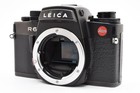 | £439.37 Buy It on eBay for only: £439.37 Buy It Now on eBay |
Used Leica R6 Camera Body
 | £402.95 Buy It on eBay for only: £402.95 Buy It Now on eBay |
Leica R6 Body + Fully Mechanical SLR Camera Body + Near Mint Condition
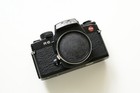 | £491.58 Buy It on eBay for only: £491.58 Buy It Now on eBay |
8 replies on “Leica R6”
The Leica R6 does not have Program, Aperture or Shutter Priority modes as stated in this article. It is a fully manual exposure camera.
you are correct, good spot. Article has been adjusted. Please comment if you see anything else incorrect.
Great article and much appreciated. This amazing piece of Leica engineering design will live forever. My all-time favourite 35mm film camera!
PS- btw next to impossible to trigger this shutter button by accident. Deeply indented in the shutter speed dial and needs considerable amount of pressure to activate. As far as “shortcomings” – IMHO there are nine with the Leica R6!
I’d love to get my hands on one but can’t stomach the cost.
Glad you enjoyed the article!
I switched to Leica with the R4 and helped influence the R4s-2 and then switched to the R6, as a professional working in studio as well as on location the R6 was a fantastic dependable tool with the great Leica lenses. Paired with Kodachrome 64 it turned out amazing imagery. i still have one, but alas no Kodachrome.
Thanks for the detailed review.
Note: in 1988 Nikon released the QV-1000C. It was an electronic still video camera (to quote them) and the storage medium for it was the “still video floppy” a 2-inch floppy disk (see photo). Even it is were using a CCD sensor it was different from a digital camera and more like the SONY Maniac released in 1981.
Even if it were using a CCD … it was more like the SONY Mavica of 1981 [sorry, automatic spell check modified my original message]