Categories
1990's Pentax

Pentax Z-1

Pentax Z-1

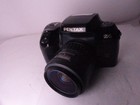
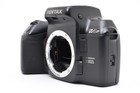
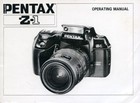
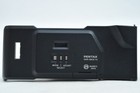
The Pentax Z-1, also known as PZ-1, is a high end 35mm SLR from Pentax, first released in 1991. It has autofocus and utilizes all Pentax lenses with a K-mount. The  styling is similar to the Pentax SFX.

Lenses

  • KAF lenses support practically all features of the camera, except powered zoom
  • KA lenses can be used with the ‘AF adapter 1.7X’, this will then support autofocus. Without the adapter, they do not support autofocus but the focus indicator, shutter-priority AE and Programmed AE modes can all be used.
  • K mount lenses with manual aperture can be mounted with an adapter. They do not support shutter-priority AE or programmed AE modes, but can be used for aperture-priority AE and in manual exposure.
  • 42mm screw-mount lenses can be mounted with an adapter. Aperture-priority AE and manual exposure are possible and the focus indicator can also be used if the lens aperture is wide enough.

Controls

The camera has the screen built into the top of the camera with the flash hot shoe over to the right, behind the shutter release. Having the flash to the side potentially helps with red eye.

It has two control dials, one on the front just behind the shutter release and when on the back where your thumb would naturally rest. There are two buttons, one labelled IF and one labelled ML. which control the metering pattern and exposure compensation.

It also has two power settings, one mode allows the camera to be used in fully automatic mode with not a lot of customisation possible, and another mode which allows the camera to be used to its full potential.

More buttons on the back are used to control the date stamp function, they set the date and time, and another button is used to set the date format to be imprinted on to the film.

Shooting modes

The Pentax Z-1 comes with a range of exposure modes, the full usable choice depends on the lenses being used. The modes are:

  • Hyper program mode
  • Program mode
  • Shutter Priority mode
  • Aperture Priority mode
  • Hyper manual mode
  • Manual mode

The Hyper program mode offers a fully automatic exposure mode with the option of quickly switching into Aperture priority or shutter priority mode.

Hyper manual mode is an extension of manual exposure but the camera has some automated settings to help. Using the IF button will set up the exposure as a starting point for the user. You can also lock the exposure using the ML button.

The camera also has some shooting modes such as single shot and continuous shooting mode. Theirs is a exposure bracketing mode where you take 3 photos with different exposures that you set beforehand. There’s a multiple exposure model where the camera will take multiple pictures without advancing the film to create some interesting effects. There’s also a range of self-timers and an interval mode.

Conclusion

The camera, like other old Pentax cameras, can be picked up quite cheap second-hand. It uses a range of lenses and has some more advanced features compared to older models.

Categories
1980's Pentax

Pentax SF7

Pentax SF7

The Pentax SF7, called the SF10 in the United States, is an autofocus 35mm SLR made by Pentax. It was released in 1988 and was intended to be used with Pentax F series lenses. It is their third autofocus camera, after the Pentax SFX.

Shooting modes

It comes with several shooting modes, programmed and shutter-priority autoexposure require control of the lens aperture, and so only available if an F-series lens is used.

  • A-series lens support most functions including shutter-priority and programmed AE.
  • M-series lenses do not support shutter-priority or programmed AE.
  • 42mm screw-mount lenses can be used but no AE modes can be used.

Settings are displayed in an LCD panel on the rear of the camera, shooting modes are selected using a mode button on the left. Plus, there’s also a selector switch to adjust setting within each mode.

The Pentax SF7 has a shutter speed between 1/2000 to 1 second. There is no conventional cable release socket, an electronic cable release is available for use with slower shutter speeds.

Accessories

The camera is compatible with a range of Pentax flashes. It supports programmed auto flash or TTL metered flash. There is also a small built-in flash. There is a hot shoe behind the shutter release.

The camera reads DX-coded 35mm film with speeds between ISO 25 and ISO 5000. It will default to ISO 100 if non-DX-coded film is used.

The camera requires a 2CR5 6V battery to power the screen.

It has a built-in film motor but it isn’t automatic, there is a button at the bottom of the camera. Also, it can also do both single and continuous shooting and has a self-timer.

Conclusion

This is another camera that can be picked up quite cheap by hobbyists or collectors. It is a simple camera to use and it’s compatible with a wide range of lenses. Some modes aren’t useable with older lenses so it’s worth checking that before buying or budgeting for some new lenses.

Categories
1980's Pentax

Pentax SFX

Pentax SXF

The Pentax SFX (SF-1 in US), dating from 1987, was the world’s first autofocus 35mm film SLR with built-in TTL auto flash.

The SFX / SF1 was Pentax’s answer to the overwhelming success of the Minolta 7000 auto focus SLR camera. Like the Minolta 7000 and unlike the much earlier Pentax ME F, the auto focus motor is integrated into the camera body. With the SFX / SF1, the new F series auto focus lenses are introduced.

The SFX / SF1 fully supports all older K, M and A-series lenses, and the F-series lenses can be used

on all K-mount bodies before and after the SFX / SF1. The SFX / SF1 was the very first SLR camera offering a built-in flash. The hot-shoe for external flashes now sits on top of the large camera grip, so that internal and external flashes can be used simultaneously.

Shooting

The Pentax SFX modes and switches are controlled with 3 rocker switches, an exposure lock button on the back, the aperture dial on the lens and an extra switch on the lens. The modes and options and viewed on a screen on top of the camera, which is unusual compared to most cameras. It also has a pop-up flash.

Selecting different shooting modes can be quite confusing. The choice of modes available depends on what option is selected on the lens. This is definitely a camera that’s worth getting hold of an instruction manual.

The Pentax SFX comes with a very large viewfinder. It doesn’t contain any information about the shooting mode, and only contains a centre focusing spot. Taking photos is simply a case of pointing at the subject, half pressing the shutter button to autofocus, and then shooting. There is a 3 LED system to help you see if your picture is in focus, it turns green when everything is in focus. There is also a beep when in focus that can be turned off if you wish.

Noise

Arguably, the biggest failing of the camera is the noise it makes. Some of the lenses are quite noisy. The shutter is very noisy and the film advance also makes quite a noise. The noise could make some people quite nostalgic but it won’t be suitable to be used in some environments.

Conclusion

In conclusion, the camera can be picked up cheaply and if it’s in good condition can be lots of fun to play around with. It is compatible with a large choice of lenses making it suitable for lots of people. The menus and buttons can be confusing and the noise may mean it isn’t a great choice for all people but the simplicity of the screen and viewfinder and autofocus aids will make taking photos a joy.