Categories
1980's Olympus

Olympus OM-20

Olympus OM-20

Introduced in 1983, the Olympus OM-20 (OM-G) was the second camera in Olympus’ double-digit OM series. Built as a consumer version of the OM-2, the OM-20 had the same features as the OM-2, but a less strong build with some compromises in design.

How awesome would it be if you had?

  • A vintage camera that you could carry around and use without worrying about damaging it.
  • A camera with a body that’s cheap and easy to find, and
  • One that supports both manual and automatic modes.

With the Olympus OM-20, it’s possible to have a camera that does all the above and more.

However, despite the lack of a metal chassis, fixtures and fittings of the OM-2, the OM-20 is an excellent camera to use with some incredible features.

Features of the Camera

One feature that made the OM-G such an incredible camera was the near-perfect metering system.

The OM-20 came with a sensor that measured the light reflected off the film. Opposed to the previous methods that measured light entering the exposure chamber, the OM-20’s approach was more accurate.

This feature makes it easy for a photographer to set exposure more precisely.

And that’s not all

The OM-20 also features an aperture priority system when set in automatic mode, which is excellent for beginners.

With this system, the camera becomes relatively easier to use. All you have to do is set the aperture value, and the camera sets the perfect shutter speed.

With this feature, you can focus more on the depth of field.

As if that’s not enough…

The OM-20 also supports a manual mode.

So, if you’re one of those people who prefer shutter priority shooting, the OM-20 has got you covered. Unlike the OM-10 which required you to plug a manual adapter to use shutter priority, the OM-20 comes with an inbuilt manual mode.

With this manual mode, you can comfortably capture objects in motion—though it’s a little tricky and requires experience.

And there’s more…

The OM-20 was also built always to be ready to take a picture.

Even when switched off, you can pick up the camera and take a picture, thanks to the automatic exposure mode.

Talk about convenient

Physical Description

Despite the plastic body, the OM-20 feels nice and sturdy.

The camera controls are well laid out. You have everything on your fingertips.

When holding the camera to your eye, you can:

  • Adjust the aperture value by moving the ring located at the front of the lens.
  • You can also adjust focus using the ring located behind the aperture ring.
  • If using manual mode, you can adjust the shutter speed by moving the ring located at the base of the lens mount.

The buttons at the top of the camera are also conveniently placed and easy to use.

To change ISO /ASA, all you need to do is rotate the knob located at the top right plate. The same knob can be used to adjust exposure compensation.

The film advance lever is on the far right of the camera. It’s not as strong as in the previous cameras, but it’s very stable and easy to use. There’s a film rewind button on the front of the camera.

To switch between automatic and manual mode, use the knob located on the top left plate of the camera. The same switch can be used to check the battery level.

All features of the camera have been designed ergonomically to make the camera easy to handle—even for beginners.

Unlike the viewfinder needle in its predecessors, this camera uses LED displays to show the shutter speed and exposure compensation.

It also came with provisions for attaching a steady-grip when working with the camera. The OM-20 also features a hot-shoe mount and a 12 seconds self-timer.

Shortcomings of the Camera

To make the OM double-digit cameras more affordable, Olympus made these cameras from less durable raw materials, and they reduced the shutter-speeds. While the single-digit OM’s could achieve a shutter speed of 1/2000s, the OM-20 had a 1/1000 seconds shutter speed.

Another shortcoming is the loud shutter noise that the OM-20 produces.

Final Thoughts

Despite being cheaply made, and having a slower shutter speed, the OM-20 is still an excellent camera.

You can always find one on the internet. Its parts are also easy to find.

It also uses the same accessories as other OM cameras. So, you don’t have to worry about using anything other than the incredible Zuiko lenses.

If it’s your first SLR, you can rest assured that you’ve made the right choice by purchasing the Olympus OM-20.

Products

SLR Film Cameras Inc Olympus OM-20, Pentax, Contax & Canon Bodies Only x 4

£0.99  (1 bid)
End Date: Sunday Sep-27-2026 22:04:00 BST

Bid

SLR Film Cameras Inc Olympus OM-20, Pentax, Mamiya & Canon Bodies Only x 4

£0.99  
End Date: Saturday Sep-26-2026 20:09:00 BST
Buy It on eBay for only: £0.99
Buy It Now on eBay

Olympus OM-10 Film Camera Inc. Zuiko 50mm f1.8 Lens.

£21.50  
End Date: Monday Sep-28-2026 14:00:09 BST
Buy It on eBay for only: £21.50
Buy It Now on eBay
Categories
1980's Olympus

Olympus OM-4

Olympus OM-4

The Olympus OM-4 is the perfect blend between an electronic and classic camera. Like the Nikon F, the OM-4 was a gamechanger for Olympus.

Mass-produced from 1983 to 1987, the OM-4 was the last camera in the OM series. It used a similar body to the OM-1 and OM-2 but featured a few improvements.

So, what makes this camera unique?

Camera Features

One of Olympus OM-4’s most distinct features is the radical shift in how the camera metered.

The OM-4 featured a fantastic spot metering system that was intuitive and easy to use. With the switch of a button, you can easily switch between the default multi-spot metering system and spot metering system.

And that’s not all

The OM-4 also features a system for exposure compensation.  Coupled with the spot metering feature, you’ll surely enjoy shooting heavily backlit subjects.

As if that’s not enough

The OM-4 comes with a spectacular viewfinder.

With just the right combination of modern technology and a design that still looks retro, the OM-4 viewfinder is one of its most significant features.

Similar to previous OM versions, the viewfinder is large and bright. However, rather than a needle metering system, the OM-4 features an LCD at the bottom of the viewfinder.  The LCD displays a 36-segment bar graph that indicates the best shooting shutter speed for different scenes.

Speaking of shutter speed…

The OM-4 features faster shutter speeds of 1/2000.

And the best part…

Despite having an electronically controlled shutter, the OM-4 can still be operated using a dead battery. All you’ll have to do is set it to both “B” and 1/60th speed modes.

The ability to use the camera with dead batteries means you can easily test it if you come across it in a thrift shop or garage sale but don’t have batteries around.

What about the accessories?

Like it’s predecessors, the Olympus OM-4 uses the incredible Zuiko lenses—you can interchangeably use the accessories from other Olympus cameras in your collection.  

Physical Appearance and Design Features

Like any other single-digit OM camera, the Olympus OM-4 was well built.

If you’ve handled the OM-1 or OM-2, the OM-4 is not very different. Other than a few added buttons, the OM-4 features the same minimalist design as it’s predecessors.

At first glance, you’d dismiss the OM-4 as another 80’s electronics—cheap and plasticky. However, the OM-4 has very few plastic parts. Even the shutter release button is solid metal.

On top of the camera you have:

  • The ISO adjustment and exposure compensation dial at the left
  • The manual, auto and battery check switch
  • A fixed hot shoe
  • Highlight and shadow buttons
  • Shutter release
  • Film advance

The face features an aperture dial, the focusing ring, and a shutter speed dial. Having these three features on the same plane means that you can easily adjust these settings without taking your eye off the viewfinder.

Below the hot shoe mount, there is the diopter adjustment that moves from +2 to -2. This adjustment can come in handy if you wear glasses.

Shortcomings of the Camera

Early versions of the OM-4 were blasted for a design flaw that resulted in the battery draining extremely fast. These early versions used the battery even when the camera was set in manual mode.

To save the battery, you have to remove them when not using the camera or you could set the shutter speed to ‘B’.

Olympus however, released the Olympus OM-4T and Olympus OM-4Ti which fixed the battery drain issue.

Final Thoughts

Other than the battery drain issue, the Olympus OM-4 is a pretty amazing camera.

It combined the compact design of the OM-1 and OM-2, and the advanced features of the OM-2n and the OM-3 to give the best experience you’ll ever get with a 35mm SLR camera. The OM-4 is a worthwhile addition to any photographer.

Categories
1980's Olympus

Olympus OM-3

Olympus OM-3

Talk about hard to find.

The Olympus OM-3 is the second rarest Olympus camera – after the M-1.

Produced between 1983 and 1986, the OM-3 is a “cult camera”—most manual camera collectors will pay top dollar for it.

But what’s so amazing about this camera?

Unique Features

Olympus cameras never fall short of unique features.

The OM-1 was known for its legendary small size and excellent viewfinder. The OM-2 became the first camera to have the Automatic Dynamic Metering (ADM) TTL system.

The OM-3 was not any different.

The Olympus OM-3 came with the multi-spot metering in addition to the center-weighted metering that was available in OM-1 and OM-2 cameras.

By including a multi-spot metering feature, the OM-3 was able to calculate a more accurate ideal exposure for every image.

And that’s not all

The Olympus OM-3 also came with highlight and shadow buttons. With these buttons, a photographer was able to identify which parts of the image could be exposed as black or white.

The camera also featured an LCD readout that replaced the needle in the viewfinder.

If you didn’t like the automatic exposure feature in the OM-2, the OM-3 went back to being fully mechanical.

Being fully mechanical, the OM-3 allows you to shoot in sunny 16 and still get the exposure right without using batteries. But if you can’t guess the exposure, the metering modes are always at your disposal.

What about Shutter Speed?

The OM-3 comes with a shutter speed of 1/2000 that makes this camera ideal for outdoor shots. With the extra shutter speed, you can comfortably use a fast lens with the OM-3.

As if that’s not enough

The OM-3 also featured improvements to the high-speed sync flash

Design Features

The OM-3 features the same minimalist design as its predecessors. The body is mainly composed of aluminum, with the top and bottom plates being made from Titanium. 

Unlike its predecessors which featured a removable hot-shoe, the OM-3 came with a fixed hot-shoe.

The face of the OM-3 did not feature a self-timer switch.

Most buttons are located at the top of the camera.

Shortcomings of the camera

If you’re used to the other OM cameras, you might have some trouble getting used to the OM-3.

One of the first differences you’ll notice is the harsh film advance. Unlike the OM-1 and OM-2, which have a particular slick advance, the OM-3 features steel gears, which makes advancing the film feel a bit harsh.

It also lacks the self-timer; you can forget about taking photographs of yourself and with your friends.

The OM-3 is also not the best for beginners. It was designed to provide specific advanced features to more experienced photographers.

Few of them were released, which makes it extremely hard to find.

Final thoughts

It’s fair to say that the OM-3 was an upgraded version of the OM-1 and the mechanical sister to the OM-4.

Despite lacking some features, the OM-3 is an excellent camera for any outdoor photographer.

It doesn’t disappoint. Being fully mechanical, you can keep shooting even when the battery runs out.

And that’s not all

The mechanical shutter gives this camera a sense of swiss watch perfection and artistry.

If you’re looking for a rare mechanical camera with impressive features, the OM-3 is your best bet—if you can find one.

Categories
1980's Nikon

Nikon F3

Nikon F3

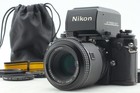
The Nikon F3 was Nikon’s third professional camera after the F and F2. First introduced in 1980, the F3 was a fully electronic 35mm SLR camera.

Now here’s a camera that has stood the test of time.

Despite an initial backlash due to the fully electronic system, the F3 became one of the most successful cameras in the Nikon line, with production lasting for 21 years. It even outlasted the Nikon F4 and F5.

But what made this camera so popular?

Keep reading to find out.

Features of the Camera

The F3 didn’t feature any new technological advancements. It didn’t have any new features. Instead, Nikon consolidated all the best features of the best cameras at the time to create one of the greatest cameras of all time. 

One of these features was the use of modular parts that could be easily interchanged. The F3 came with a choice of five interchangeable viewfinders, namely:

  • DE-2 Standard
  • DE-3 High Eye-Point (HP)
  • DA-2 Action Finder
  • DW-3 Waist-Level
  • DW-4 6x Magnifying

If you wear glasses, this is the camera for you. The High Eye Point (HP) eyepiece is a slightly larger eyepiece with a slightly reduced magnification, making it perfect to use if you wear glasses. 

All the viewfinders are bright and are a pleasure to look through. The F3 also featured a digital LCD meter that was visible when looking through the viewfinder.

Talking about metering, how was the F3 metering?

The F3 used the center-weighted metering system. Unlike the F2, which had the metering system in the eyepiece, the F3 metering is located in the body. This feature brought back the ability for Through the Lens (TTL) metering.

Other Features

Another feature that makes the F3 one of the most excellent SLR cameras of all time is its ease of use. The Nikon F3 is an aperture priority camera, which is superb.

With this camera, you only have to think about the depth of field and how creative you want the shot to be. The camera sets the shutter speed for you.

And that’s not all…

The F3 comes with a high range of shutter speeds, which makes it perfect for shooting at different speeds. You can set the shutter speed manually using the shutter speed dial on the top plate. You get a range of 1/2000 sec to 8 sec.

The shutter sound is also quite distinctive. Not silent or noisy, but very unique. Some even claim that the F3 shutter noise was the go-to camera sound for mid-1980s commercials and films.

What about lenses?

The F3 accommodates a large chunk of the Nikon lens lineup. With this camera, you can use all manual Nikon lens produced since 1959., as well as all autofocus lens including the AI-P, AF, AF-I, AF-D and AF-S lenses

Design and Physical Appearance

A universal agreement is that the F3 is a beautiful camera with an innovative design.

Designed by legendary car designer Giorgetto Giugiaro, the F3 features several cutting-edge design features.

First off, all the edges are perfectly rounded, making the camera feel natural to the hand. The F3 was also the first Nikon camera to feature the iconic red stripe that is present on all other Nikon cameras.

All controls are ergonomically placed to ensure ease of the camera.

When holding the camera, you can advance the film with your right thumb. Next to the film advance crank, you have the electromagnetic shutter release button and the shutter speed dial.

On the left top plate, you have the film rewind crank, and the exposure compensation and ISO dial.

The F3 does not have a hot or cold shoe.

Shortcomings of the Camera

One of the most common complaints about this camera comes from people who want to use a flash system with it.

This camera relies on a peripheral adapter that’s located near the film rewind. To rewind the film, you’ll need to remove the flash system.

Another shortcoming is that the LCD is hard to read in low light. Long time users have also reported LCD failure with some cameras.

Final Thoughts

The F3 is an incredible camera.

It’s easy to use, feels comfortable on the hand, and is not as heavy as the F2. Despite it being a professional camera, the F3 is also great for everyday use.

The shutter system is excellent, metering is spot on, and the viewfinder is a pleasure to look through. Not forgetting the wide range of accessories you can use with this camera.

What more could a photographer ask for?

Categories
1980's Nikon

Nikon F4

Nikon F4

Not many cameras had the kind of features you’d want in the 1980s, except for the Nikon F4. These included:

  • Tough, durable, and reliable
  • Has diverse metering modes,
  • Came with a wide array of creative controls, and
  • Featured Automatic Focusing.

Released in September 1988, the F4 was the camera that brought SLR into the modern world—a real game-changer.

Here are some of the features that made the F4 such a game-changer.

Features of the Camera

Previous cameras in the Nikon F series were mainly improvements of what existed at the time.

  • The Nikon F improved on what Leica and Contax already had in the market. 
  • The F2 was an improved and reworked version of the F
  • The F3 was an evolution of the F2. It was an electronic version of the F2.

The Nikon F4 was different. It was built from scratch. Unlike its predecessors who didn’t come with any new technological innovations, the F4 featured several first.

It was the world’s first professional autofocus camera.

Automatic focus cameras had just started gaining popularity, and many professional photographers were looking for a good AF camera. Being the first pro AF camera made the F4 the top sports and News camera from 1989-1990.

The Nikon F4 was also the world’s first professional camera to feature the modern multi-pattern metering system. Although Nikon had earlier introduced a matrix metering system in the FA, the F4 had a more improved and accurate version.

With the F4, a photographer could choose between three metering modes.

  • Matrix
  • Centre-weighted
  • Spot metering

It was also the first camera with an electronically controlled vertically traveling focal plane shutter, and a shutter release on the vertical and horizontal grip.

The electronic shutter speed allowed the camera to achieve shutter speeds of between 30 sec-1/8000 sec—faster than any camera at the time.

Other Features

The Nikon F4 was also the first camera to feature an in-built motor drive. Previous cameras relied on an external motor.

Other than being a first, the F4 also had several extraordinary features.

One of these features was the large and bright viewfinder. The F4 came with a removable multi-meter finder DP-20 pentaprism. If you thought the F3 had an excellent viewfinder, the F4 had a better one.

And it wasn’t just one viewfinder,

The F4 came with a choice of ten easily interchangeable finders.

Nikon wasn’t done.

The F4 also featured a record five exposure modes. You had the choice of

  • Manual mode
  • Shutter priority
  • Aperture priority
  • Program mode
  • High-speed program mode.

What about lenses?

The F4 could accommodate all Nikon lenses produced since 1959.

Design and Physical Appearance

Legendary car designer Giorgetto Giugiaro designed the Nikon F4. The camera followed Giorgetto’s philosophy of Form follows Function.

Every part of the camera had to have a useful function.

And the result? An ergonomic masterpiece.

The F4 was the last professional camera with knobs and levers. Professional cameras after the F4 made use of menus and dials.

Thanks to the use of an in-built motor drive, the F4 didn’t come with a film advance lever.

Shortcomings of the Camera

One of the most significant complaints among F4 users is its weight. The F4 was a beast of a camera with a weight of 1280g without batteries.

It’s not the camera for a daily shooter.

The F4 autofocus was also not the best. It was slow and performed poorly in low light—the main reason the F4 didn’t experience much success.

Compared to the F5, the F4 matrix metering system was not the best.

Final Thoughts

The Nikon F4 was a revolutionary camera. It sits at the epicenter of the modern camera revolution.

Is the Nikon F a good camera for 2020?

Short answer, yes.

Not only is the F4 compatible with all manual and autofocus lenses manufactured since 1959, but it’s also still a great camera to carry and shoot with.

Categories
1980's Nikon

Nikon F3AF

Nikon F3AF

The Nikon F3AF was born. A special and unique version of the highly famous F3. However, unlike other models in the F3 line, the F3AF came with some unique features.

The year is 1983.

Camera manufacturers are experimenting with prototype autofocus SLR cameras. Pentax, Olympus, and Canon already have experimental AF SLR models in the market.

Nikon, on the other hand, chooses a more radical approach. Rather than launching AF in a new flagship model, they choose their top of the line Nikon F3 as the template for their first autofocus camera.

Here’s a breakdown of some of the features of the Nikon F3AF

Features of the Camera

We’ll start with the most obvious.

The Nikon F3AF was an autofocus (AF)35mm SLR camera.

And not just any other AF 35mm SLR camera. It was among the first if not the first SLR to have an AF system based on Through The Lens (TTL) detection. Previous AF cameras from companies such as Canon used active infrared sensors for their AF system.

Another unique feature of the Nikon F3AF was the unique pentaprism.

The camera came with an AF finder DX, which featured a bright viewfinder with a 92% coverage—unlike other F3 models that had a 100% coverage on the viewfinder.

And that’s not all

The F3AF featured a superb 80/20 center-weighted metering system. It also came with a 150,000 cycle shutter reliability rating.

Talk about a camera built to last.

And there’s more

The F3AF was launched together with two AF lenses. These were:

  • AF Nikkor 80mm f/2.8
  • AF Nikorr 200mm f 3.6 EDIF

Despite having its lenses, Nikon maintained the F-mount, which meant that the F3AF could use all other Nikon lenses since 1959. The two lenses could also be used in manual Nikon SLRs.

As if that’s not enough…

The lenses also came with a revolutionary design. A feature that wouldn’t catch on until 15 years later.

Both lenses came with an in-lens motor that drew power from the camera. Cameras at the time and many cameras until the early 2000s had the motor inside the body and not the lens. 

The autofocus feature of the lens, as well as the increased zoom capability, made the lenses and the camera quite popular among sport and action photographers.

Design and Physical Appearance

The Nikon F3AF had the same design as the F3.

The F3AF was easy to handle and comfortable on the hand. It featured a subtle bump at the face of the camera to aid with your grip.

Most of the controls were located at the top.

On the top plate, you had:

  • The frame advance crank on the right
  • The shutter speed dial on the right
  • The shutter release button on the right.
  • The top left plate housed the Exposure compensation and ISO dial.

Shortcomings of the Camera

One of the most significant shortcomings with the F3AF was the weight of the AF lens. The AF lenses were heavier than other Nikon manual lenses.

Like the F3, the F3AF also has problems with the LCD, which seems to lose functionality in time. You may have to replace it after prolonged use.

The autofocus system was also not perfect as compared to other later cameras. However, the F3AF also featured a manual focus mode. 

Final Thoughts

The F3AF was the most unique of the F3 series. Although it didn’t experience as much success as other F3 cameras, it is still an incredible camera.

A trendsetter for the Nikon AF family and a worthy addition to your vintage camera collection.

Categories
1980's Canon

Canon T90

Canon T90
BrandCanon
Release Year1986
Release Price148,000 yen (~$1,350)
Lens MountFD Mount

Developed as the top-of-the-line T-series camera, the Canon T90 is a multi-mode SLR with built-in motor drive. The form of the pentaprism hump is a distinct characteristic but instead of being sharp-edged like on previous cameras, it is rounded with smooth curves. The camera was designed to lessen the picture-taking burden on the user via automation. It aimed for seamless operation to respond to the user’s will. A lot of top-notch technology and thought went into the camera.

Design

The form of previous cameras was largely dictated by the required locations of mechanical controls on the body, such as the film advance lever, rewind crank, shutter speed dial, shutter release, etc. On the T90, the film transport control is no longer required, while the others are no longer mechanically linked. This gave the designers more freedom to shape the camera to make it easier to control and hold, and to place controls in a way that suited the user rather than a mechanical design. Much work went into human factors engineering to create an ergonomic user interface for the camera.

Metering

The camera has three metering systems to suit diverse shooting conditions as well as eight autoexposure modes and two manual exposure modes also make the camera highly versatile. Drive operations are divided among three small coreless motors to consume less power. With four size-AA batteries, the built-in motor drive can shoot at a maximum of 4.5 fps. It was truly a top-of-the-line camera and in Japan, the camera’s nickname was “Tank.”

Conclusion

It is the last professional-level manual-focus camera from Canon, and the last professional camera to use the Canon FD lens mount. Although it was overtaken by the autofocus revolution and Canon’s new, incompatible EOS (Electro-Optical System) after only a year in production, the Canon T90 pioneered many concepts seen in high-end Canon cameras up to the present day, particularly the user interface, industrial design, and the high level of automation.

Categories
1980's Canon

Canon T80

Canon T80
BrandCanon
Release Year1985
Release Price85,000 yen (~$775)
Lens MountFD Mount

Canon’s first autofocus 35mm SLR camera. The AF system uses a linear CCD array for TTL image contrast detection. The picture-taking mode can be selected with the pictographs on the external LCD panel.

For metering and exposure control, TTL multi-program AE and preset aperture AE with centerweighted averaging metering are provided. Lenses for autofocusing with the T80 were called AC lenses. These lenses had the FD mount and signal transmission capability. Three such lenses were available: AC 50mm f/1.8, AC 35-70mm f/3.5-4.5, and AC 75-200mm f/4.5.

Film transport in the Canon T80 is completely automatic, just as in the Canon T70, in both directions. This leaves the top of the camera very clean, since there is no advance lever or rewind knob. Film loading is automatic; the user only has to align the film leader with an orange mark and close the back, and the camera loads and advances the film automatically. Indicators on the top LCD display the status of loading, winding and rewinding. The motor, and the camera’s other functions including the focusing motor in the lens, are powered by 4 AAA batteries housed in the base of the camera.

A Command Back 80 was available for the Canon T80. It supports date stamping of images, alphanumeric coding of images, time exposures and time-lapse interval exposure.

Categories
1980's Canon

Canon T70

Canon T70
BrandCanon
Release Year1984
Release Price69,000 yen (~$630)
Lens MountFD Mount

The Canon T70 was a 35mm FD-mount single-lens reflex camera introduced in April 1984 as the second in Canon’s T series. It started with the concepts explored in the Canon T50, took them further, and applied them to a more sophisticated camera. While the Program AE-only T50 was intended as a beginner’s camera, the Canon T70 gave the photographer a lot more control over the camera’s operation while keeping the T-series philosophy of simplicity in control and operation intact.

When it was introduced, the Canon T70 was considered technologically advanced compared to other SLR cameras. Reviewing the camera in Popular Science, Everett Ortner said that the camera “could be…too good for amateurs. It is certainly far removed from those other technological wonders designed for amateurs”. He praised the high degree of control, coupled with automation, that the T70 allows photographers to use, reducing “the role of the camera from that of master to servant.”

Categories
1980's Canon

Canon T50

Canon T50
BrandCanon
Release Year1983
Release Price45,000 yen (~$410)
Lens MountFD Mount

In the early 1980s, the SLR still dominated. Metering systems diversified as camera makers competed fiercely to offer the better camera. The confusion may have turned off users as more people began to avoid SLRs.

In 1981, 35mm SLR production peaked at 7.67 million units. Two years later, this amount shrank by more than 30 percent to 5.37 million units.

Amid such market conditions, the Canon T50 was introduced as a wave-of-the-future 35mm SLR camera. It was the first T-series camera. The camera was designed to respond to the user automatically. It was easy to use and anybody could take pictures with it. It had a power winder (which was well received on the Autoboy) and TTL program AE. In 1983, the Canon T50 won the Good Design Award from the Ministry of International Trade and Industry.