Categories
1980's Canon

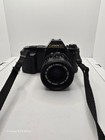
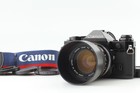
Canon T90

Canon T90
BrandCanon
Release Year1986
Release Price148,000 yen (~$1,350)
Lens MountFD Mount

Developed as the top-of-the-line T-series camera, the Canon T90 is a multi-mode SLR with built-in motor drive. The form of the pentaprism hump is a distinct characteristic but instead of being sharp-edged like on previous cameras, it is rounded with smooth curves. The camera was designed to lessen the picture-taking burden on the user via automation. It aimed for seamless operation to respond to the user’s will. A lot of top-notch technology and thought went into the camera.

Design

The form of previous cameras was largely dictated by the required locations of mechanical controls on the body, such as the film advance lever, rewind crank, shutter speed dial, shutter release, etc. On the T90, the film transport control is no longer required, while the others are no longer mechanically linked. This gave the designers more freedom to shape the camera to make it easier to control and hold, and to place controls in a way that suited the user rather than a mechanical design. Much work went into human factors engineering to create an ergonomic user interface for the camera.

Metering

The camera has three metering systems to suit diverse shooting conditions as well as eight autoexposure modes and two manual exposure modes also make the camera highly versatile. Drive operations are divided among three small coreless motors to consume less power. With four size-AA batteries, the built-in motor drive can shoot at a maximum of 4.5 fps. It was truly a top-of-the-line camera and in Japan, the camera’s nickname was “Tank.”

Conclusion

It is the last professional-level manual-focus camera from Canon, and the last professional camera to use the Canon FD lens mount. Although it was overtaken by the autofocus revolution and Canon’s new, incompatible EOS (Electro-Optical System) after only a year in production, the Canon T90 pioneered many concepts seen in high-end Canon cameras up to the present day, particularly the user interface, industrial design, and the high level of automation.

Categories
1980's Canon

Canon T80

Canon T80
BrandCanon
Release Year1985
Release Price85,000 yen (~$775)
Lens MountFD Mount

Canon’s first autofocus 35mm SLR camera. The AF system uses a linear CCD array for TTL image contrast detection. The picture-taking mode can be selected with the pictographs on the external LCD panel.

For metering and exposure control, TTL multi-program AE and preset aperture AE with centerweighted averaging metering are provided. Lenses for autofocusing with the T80 were called AC lenses. These lenses had the FD mount and signal transmission capability. Three such lenses were available: AC 50mm f/1.8, AC 35-70mm f/3.5-4.5, and AC 75-200mm f/4.5.

Film transport in the Canon T80 is completely automatic, just as in the Canon T70, in both directions. This leaves the top of the camera very clean, since there is no advance lever or rewind knob. Film loading is automatic; the user only has to align the film leader with an orange mark and close the back, and the camera loads and advances the film automatically. Indicators on the top LCD display the status of loading, winding and rewinding. The motor, and the camera’s other functions including the focusing motor in the lens, are powered by 4 AAA batteries housed in the base of the camera.

A Command Back 80 was available for the Canon T80. It supports date stamping of images, alphanumeric coding of images, time exposures and time-lapse interval exposure.

Categories
1980's Canon

Canon T70

Canon T70
BrandCanon
Release Year1984
Release Price69,000 yen (~$630)
Lens MountFD Mount

The Canon T70 was a 35mm FD-mount single-lens reflex camera introduced in April 1984 as the second in Canon’s T series. It started with the concepts explored in the Canon T50, took them further, and applied them to a more sophisticated camera. While the Program AE-only T50 was intended as a beginner’s camera, the Canon T70 gave the photographer a lot more control over the camera’s operation while keeping the T-series philosophy of simplicity in control and operation intact.

When it was introduced, the Canon T70 was considered technologically advanced compared to other SLR cameras. Reviewing the camera in Popular Science, Everett Ortner said that the camera “could be…too good for amateurs. It is certainly far removed from those other technological wonders designed for amateurs”. He praised the high degree of control, coupled with automation, that the T70 allows photographers to use, reducing “the role of the camera from that of master to servant.”

Categories
1990's Canon

Canon T60

Canon T60
BrandCanon
Release Year1990
Release PriceNot for sale in Japan
Lens MountFD Mount

The Canon T60 was the last manual focus FD-mount 35 mm single-lens reflex (SLR) camera sold by Canon; it was introduced in 1990, three years after the introduction of Canon’s incompatible EOS system of autofocus SLRs and their EF lenses. It was the final camera in Canon’s T series.

The T60 was introduced solely as a cheap SLR system for export. It was never sold in Canon’s home Japanese market. In some foreign markets, the higher price of the EOS cameras was a problem, while in others, there was demand for a cheap, largely manual camera for photography students and the like.

The Canon T60 shared little with the other T-series models except for a superficial styling resemblance. Unlike them, it had only manual film loading, advance and rewind. Film speed and shutter speed were set with traditional dials.

The only auto-exposure mode supported was aperture priority AE. The camera would choose an appropriate shutter speed. Also supported, of course, was full manual exposure, aided by the camera’s built-in meter. Shutter speed range was 1/1000 second to 1 second, plus bulb.

Products

User Manual Canon T60

£22.86  

Buy It on eBay for only: £22.86
Buy It Now on eBay
Categories
1980's Canon

Canon T50

Canon T50
BrandCanon
Release Year1983
Release Price45,000 yen (~$410)
Lens MountFD Mount

In the early 1980s, the SLR still dominated. Metering systems diversified as camera makers competed fiercely to offer the better camera. The confusion may have turned off users as more people began to avoid SLRs.

In 1981, 35mm SLR production peaked at 7.67 million units. Two years later, this amount shrank by more than 30 percent to 5.37 million units.

Amid such market conditions, the Canon T50 was introduced as a wave-of-the-future 35mm SLR camera. It was the first T-series camera. The camera was designed to respond to the user automatically. It was easy to use and anybody could take pictures with it. It had a power winder (which was well received on the Autoboy) and TTL program AE. In 1983, the Canon T50 won the Good Design Award from the Ministry of International Trade and Industry.

Categories
1970's Canon

Canon AV-1

Canon AV-1
BrandCanon
Release Year1979
Release Price57,000 yen (~$520)
Lens MountFD Mount

Even though the camera would cost more, shutter speed-priority AE cameras were important to Canon since users could comprehend shutter speeds easier than aperture settings. However, in America and other overseas markets, aperture-priority AE 35mm cameras were in the majority.

Overseas distributors also clamored for an aperture-priority AE model. Canon responded with the Canon AV-1.

The Canon AV-1 was very similar to the Canon AE-1 but provided aperture priority auto-exposure rather than the AE-1’s shutter speed priority AE. The camera is not capable of fully manual exposure.

The AV in the name referred to the type of auto-exposure; Av (Aperture Value) is a common abbreviation for aperture priority.

When the Canon AV-1 appeared, a new range of FD lenses was introduced, with instant mounting/unmounting of the lens. This was called the New FD mount and did away with the older type of mounting ring which was fitted on to the rear of the lens and was awkward to use and needed two hands, to a newer, easier system whereby the user lined up the red dot on the lens, with the red dot on the camera and simply turned the whole lens clockwise until it clicked into place.

Categories
1970's Canon

Canon AT-1

Canon AT-1
BrandCanon
Release Year1976
Release PriceNot sold in Japan
Lens MountFD Mount

The Canon AE-1 with shutter speed-priority AE and TTL metering became wildly popular in Japan and overseas.

However in a few overseas markets, the AE-1 had a high price tag. There were also many users who still preferred manual metering. In response to these people, the Canon AT-1 was developed. It had the same body as the AE-1. It featured match-needle metering and TTL center weighted averaging metering with CdS photocell. The camera could use the same accessories as the AE-1.

Categories
1980's Canon

Canon AL-1

Canon AL-1
BrandCanon
Release Year1982
Release Price58,000 yen (~$530)
Lens MountFD Mount

The Canon AL-1 was a 35mm film SLR camera introduced by Canon in 1982. It was designed to be an advanced, automatic camera that was easy to use, while still offering many manual controls.

Targeting users who had difficulty focusing through the viewfinder, the Canon AL-1 featured an electronic focus-assist system besides aperture-priority AE.

The system searches for the peak of the subject’s image contrast obtained by three linear CCD arrays. The bottom of the viewfinder has arrows indicating the direction to turn the focusing ring to achieve focus. When focus is achieved, the in-focus mark between the two arrows lights.

The exposure is controlled by a TTL silicon photocell and aperture-priority AE with centerweighted averaging metering. All shutter speeds are electronically controlled and stepless. The camera is also compatible with all FD lenses which allowed photographers to use a wide variety of high-quality lenses..

Categories
1980's Canon

Canon AE-1 Program

Canon AE-1 Program
BrandCanon
Release Year1981
Release Price60,000 yen (~$550)
Lens MountFD Mount

It was five years after the Canon AE-1 became a worldwide hit. Many users wanted the program AE mode that was featured in the Canon A-1. This mode set both the shutter speed and aperture automatically. The user just had to press the shutter button.

The Canon AE-1 Program camera was developed in response to the demand for program AE and to succeed the original Canon AE-1. The camera now had both shutter speed-priority AE and program AE modes. It also sported a palm grip like the Canon A-1. The camera was also compatible with the A-1’s Motor Drive MA. The viewfinder featured LEDs. It was quite an advanced camera.

To make Motor Drive MA compatible with the Canon AE-1 Program camera, it had three electrical contacts instead of only two which the original version had. Also, Power Winder A was converted into Power Winder A2 for higher performance.

Categories
1970's Canon

Canon AE-1

Canon AE-1
BrandCanon
Release Year1976
Release Price81,000 yen (~$740)
Lens MountFD Mount

Introduced in April 1976, the Canon AE-1 was a very successful camera worldwide. When it came out, TTL manual-metering models (including the Canon FTB QL were still the mainstream in the 35mm SLR market. Auto-exposure models were still at the very top end of the SLR market. They were expensive and produced in small numbers.

The camera, however, was designed from the ground up with five major units and twenty-five minor units. They were centrally controlled by a microcomputer. By incorporating electronics, the parts count could be reduced by 300. The manufacturing of the camera was also highly automated. This made it possible to produce a low-cost camera having high-end features.

Overall, the Canon AE-1 was a groundbreaking camera that offered advanced features, excellent performance, and ease of use. It played a significant role in popularizing photography as a hobby and making high-quality cameras more accessible to a wider audience. Therefore, it can be said that the Canon AE-1 was indeed a good camera.