Categories
1970's Canon

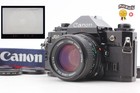
Canon A-1

Canon A-1
BrandCanon
Release Year1978
Release Price83,000 yen (~$750)
Lens MountFD Mount

The Canon A-1 was the top-of-the-line A-series camera. It was a sophisticated electronic camera with all-digital control.

Besides the shutter speed-priority AE and aperture-priority AE modes, it featured the first fully automatic program AE mode, preset aperture-priority AE, and Speedlite AE mode.

The viewfinder information was also easy to read with a 7-segment red LED readout. The control settings were displayed at the same time which made it very useful.

Besides Power Winder A, developed at the same time as the Canon AE-1, accessories for the A-1 included the compact Motor Drive MA which attained a maximum shooting speed of 5 fps. This Motor Drive had a convenient vertical-grip shutter button. Also, there was the Speedlite 199A which had bounce flash capability. The Canon A-1’s body had a fine black finish.

Categories
1970's Canon

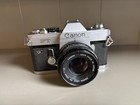
Canon TLb

Canon TLb
BrandCanon
Release Year1976
Release Price32,300 yen (~$300)
Lens MountFD Mount

The Canon TLb was marketed overseas in September 1974 as the cheaper version of the Canon FTb QL. It was later sold in Japan in April 1976. The basic specifications were the same as the Canon TX except for the hot shoe which was omitted. X-sync was possible only with the PC terminal.

It was a relatively basic camera, but it offered solid performance and was considered to be a good camera for its price range at the time.

Some of the features of the Canon TLb include:

Manual exposure control: The camera had a fully manual exposure control system, which allowed photographers to fine-tune their exposure settings.

Through-the-lens (TTL) metering: The camera had a TTL metering system that measured the light entering the lens and provided an accurate exposure reading.

Shutter speeds: The camera offered a range of shutter speeds from 1/500 to 1 second, as well as a bulb mode for longer exposures.

Lens compatibility: The Canon TLb was compatible with Canon’s FL lens mount, which allowed photographers to use a wide variety of high-quality lenses.

Lightweight design: The camera was relatively lightweight and compact, making it easy to carry around and use.

Overall, the Canon TLb was a good camera that offered solid performance and features for its price point. It was not as advanced as some of Canon’s other SLR cameras from the same era, such as the Canon AE-1, but it was still a reliable and easy-to-use camera that could produce high-quality images.

Products

Canon FD 50mm f1.8 for T70 AE-1 A-1 F-1 T90 T50 QL TLb AT-1 FT FX AL-1 AV-1 FTb

£0.01  
End Date: Wednesday Sep-23-2026 22:06:00 BST
Buy It on eBay for only: £0.01
Buy It Now on eBay

Canon TLb Instruction Manual

£8.00  

Buy It on eBay for only: £8.00
Buy It Now on eBay

Canon TLb Film SLR Instruction Manual/Guide Booklet Dutch 1970s

£2.24  
End Date: Wednesday Sep-23-2026 13:52:11 BST
Buy It on eBay for only: £2.24
Buy It Now on eBay
Categories
1970's Canon

Canon TX

Canon TX
BrandCanon
Release Year1975
Release PriceNot sold in Japan (~$290)
Lens MountFD Mount

The Canon TX was a stripped-down Canon FTb for the mass market overseas. The fastest shutter speed was only 1/500 sec. The metering pattern was center weighted averaging instead of 12% partial at the center. The stop-down lever had no locking feature. A PC terminal and hot shoe were provided for flash.

Features

Manual exposure control: The Canon TX was a fully manual camera, which meant that photographers had complete control over their exposure settings. It featured a match-needle metering system that displayed the recommended shutter speed in the viewfinder based on the selected aperture.

Through-the-lens (TTL) metering: The camera had a TTL metering system that measured the light entering the lens and provided an accurate exposure reading.

Shutter speeds: The camera offered a range of shutter speeds from 1/500 to 1 second, as well as a bulb mode for longer exposures.

Lens compatibility: The Canon TX was compatible with Canon’s FD lens mount, which allowed photographers to use a wide variety of high-quality lenses.

Self-timer: The camera had a built-in self-timer that allowed for delayed shutter release.

Flash compatibility: The Canon TX had a hot shoe for attaching an external flash, as well as a PC sync port for connecting a flash via a cable.

Conclusion

Overall, the Canon TX was a reliable and versatile camera that offered many of the same features as more expensive models, at a more affordable price point. It was a popular choice among amateur photographers and enthusiasts who were looking for a high-quality, manual SLR camera.

Categories
1970's Canon

Canon FTb QL

Canon FTb QL
BrandCanon
Release Year1971
Release Price35,000 yen (~$320)
Lens MountFD Mount

Like the flagship Canon F-1, the Canon FTb QL was compatible with FD lenses. It was a mass-market camera having the same basic features as the Canon F-1.

Like the F-1, it had maximum-aperture TTL metering, match-needle exposure adjustment, and high-precision 12% partial metering at the center. Being a mid-tier 35mm SLR camera, the Canon FTb QL was well received by many amateur photographers. It also allowed stop-down TTL metering (match needle) for FL lenses and situations when stop-down viewing was required.

The Canon FTb QL was primarily intended to be a camera for the advanced amateur photographer, offering many of the same features and same build quality as the Canon F-1, but without the option of interchangeable prisms, focusing screens, or motor drives.

The Canon FTb QL has an all-mechanical horizontally traveling focal plane shutter with timed speeds from 1/1000 to 1 second and bulb. The FTb has rubberized silk shutter curtains rather than the more durable but more expensive titanium curtains found on the F-1.

In 1973, the FTb design was revised slightly. The camera was given a plastic tipped film advance lever plus, the stop down lever was changed to the same style as that found on the F-1. The PC sync socket was given a spring-loaded plastic cover and the ring around the outer edge of the shutter speed dial was changed from a scalloped design to a diamond textured design. Finally, a shutter speed display was added in the lower left hand corner of the viewfinder. This model was unofficially known as FTb-N or FTbn.

Categories
1980's Canon

Canon New F-1

Canon new F-1
BrandCanon
Release Year1981
Release Price149,000 yen (~$1,350)
Lens MountFD Mount

Instead of being a next-generation successor to the Canon F-1, this camera was called the “New F-1,” and not the “F-2.” With the first Canon F-1 in 1971, Canon promised that the camera would remain unchanged for 10 years. This promise was fulfilled. During those ten years, there were remarkable advances in electronics, precision manufacturing, and optics. The successor to the top-of-the-line Canon F-1 had to incorporate the best electronic technology for better automation, versatility, and specifications.

Metering

For metering flexibility, it uses interchangeable focusing screens to change the metering pattern with a segmented metering element. For automation, system AE is incorporated for optimum operation. The camera’s basic controls are also the same as the old Canon F-1 so F-1 users can easily adapt to the updated camera.

The camera is a manual-exposure camera capable of TTL full-aperture metering and stopped-down metering with the included Eye-Level Finder FN. Aperture-priority AE is available by attaching the optional AE Finder FN. Also, shutter-priority mode is optionally available when using either AE Motor Drive FN or AE Power Winder FN.

Expanding system

The New F-1 is an expandable system. It consists of interchangeable viewfinders, focusing screens, motor drives, and alternate backs, all of which are specific to the New F-1. All other Canon components, such as the FD lens series, close up accessories (bellows, extension tubes, etc.), and Canon A and T Speedlights (except the 300TL) are also compatible with the system.

There are two different motorized film advance units in the New F-1 system: the AE Power Winder FN, and the AE Motor Drive FN. The AE Power Winder FN allows up to 2 frames per second (frame/s) in continuous mode, and the AE Motor Drive allows up to 5 frame/s in high-speed mode and 3.5 frame/s in low-speed mode. Both units also have single-exposure mode, where only a single frame is exposed when the shutter release is held down. Both units also have a second shutter release for vertical format shooting, and a subtractive frame counter. Only the AE Motor Drive FN has a motorized film rewind (therefore when using the AE Power Winder FN it is not necessary to remove the Rewind Coupler cover from the bottom of the camera).

Categories
1970's Canon

Canon F-1

Canon F-1
BrandCanon
Release Year1971
Release Price78,000 yen (~$700)
Lens MountFD Mount

The Canon F-1 was a highly regarded camera and considered by many photographers to be an excellent camera. It was introduced by Canon in 1971 as a professional-grade 35mm SLR camera and was the flagship model of the Canon F-series cameras. The camera was built with a sturdy and durable design, which made it suitable for use in tough environments. It was also known for its accuracy, reliability, and versatility, making it a popular choice among photographers of all levels.

Lenses

The FD lens mount was newly developed for the new line of FD lenses. The new lens mount enabled fully-coupled automatic exposure metering. The camera system also included the first accessory ever for remote picture-taking with the camera. The many accessories enabled seamless and instant compatibility.

The Canon F-1 uses the Canon FD lens mount, which was introduced alongside the camera. In addition, between 1970 and 1979, a total of 68 different FD mount lens models were produced, ranging from 7.5mm to 800mm in focal length.

The Canon F-1 camera was built to endure 100,000 picture-taking cycles. Also, it was a well built cameras as it could handle temperatures ranging from -30 C to 60 C, and 90% humidity. Being a highly durable and reliable camera, the F-1 gained many followers including pros. Except for a one-time revision, the camera was manufactured and sold for ten years.

Viewfinder

The F-1 had interchangeable viewfinders like most professional 35 mm cameras of the 1970s. To remove the viewfinder, you must press the two small buttons at the rear sides of the finder, and slide the finder toward the back of the camera.

The camera shipped with a standard pentaprism finder, called an “eye-level finder” by Canon, also other finders available included a waist-level finder, Speed Finder, Booster T finder, and Servo EE finder.

The F-1’s back was removable. A Data Back F (for the original F-1 and F-1n), Data Back FN (which being mechanical is now incapable of putting the current year on a photo) or a bulk film back that could hold 250 exposures could be attached. The Film Chamber 250 could be used alone or with the Motor Drive Unit or Motor Drive MF (the MF’s grip had to be removed and coupled via a dedicated cord).

Conclusion

Overall, the Canon F-1 was a high-quality camera that was popular among professional photographers and hobbyists alike. Even today, it is still sought after by collectors and enthusiasts as a classic example of a well-made and innovative camera.

Categories
1970's Canon

Canon EF

Canon EF
BrandCanon
Release Year1973
Release Price~50,000 yen ($460)
Lens MountFD Mount

The Canon EF is a 35 mm SLR camera introduced by Canon in 1973. It has a Copal Square focal-plane shutter, with metal blinds running vertically which has mechanically-timed speeds from 1/2 to 1/1000 second, plus ‘B’, and electronically-controlled slow speeds from 1 to 30 seconds.

A silicon photocell provides full-aperture, center-weighted averaging TTL metering and it also has shutter-priority automatic exposure.

The Canon EF uses the FD-mount lenses, although FL lenses will work within their functional limits.

The Canon EF is similar in size and body style to the Canon F-1, which was introduced in 1971, but lacks an interchangeable focusing screen or viewfinder and has no facility for using a winder or motor drive. It was for many years a fairly high-priced rarity on the used-camera market.

Features

Frequently referred to as the Black Beauty, the Canon EF incorporated many very good and thoughtful features, such as:

  • speeds from 1/1000 to 1/2 second even without batteries.
  • full exposure information in viewfinder.
  • concentric shutter release ; shutter speed dial, the latter overlapping the front edge of the camera, allowing easy change of shutter speed with one finger.
  • incorporates voltage control circuit, allowing use of modern 1.5V batteries without needing any exposure compensation (it was designed for a 1.3V PX625 mercury cell).
  • multiple exposure button.
  • exposure lock button for use with automatic exposure.
  • film can be advanced rapidly to first frame without having to release the shutter (3 successive strokes of the wind-on lever).
  • depth-of-field preview, stopped-down metering, and mirror lock.
  • vertical-travelling shutter allows flash sync at 1/125 sec.
  • silicon photocell allows metering at low light levels (EV 2 to EV 18).
  • PC flash terminal has spring-loaded cover; the terminal is therefore kept covered and clean when not in use, and the cover cannot be lost.
  • One weakness was that, if the power switch was left on, the light meter would continuously draw battery power, even with the lens cap in place.
Categories
1960's Canon

Canon TL QL

Canon TL QL
BrandCanon
Release Year1968
Release PriceNot sold in Japan (~$199)
Lens MountFL Mount

The Canon TL QL is a simplified and cheaper version of the Canon FT QL, this camera was for the overseas mass market. The maximum shutter speed was only 1/500 sec. The camera was without a self-timer and QL feature, but it retained stop-down TTL metering. Although most TL cameras did not have QL, some cameras did as shown in the photo.

Categories
1960's Canon

Canon FT QL

Canon FT QL
BrandCanon
Release Year1966
Release Price54,800 yen (~$500)
Lens MountFL Mount

Introduced a year after the Canon Pellix, the Canon FT QL had a normal quick-return reflex mirror and stop-down TTL metering. The finder’s condenser lens was cut at a 45-degree angle. Twelve percent of the image area surface was semi-silvered with vapor deposition. The incident light reflected by this semi-transparent mirror was directed to the metering element. The viewfinder had match-needle exposure metering. The distance to the metering element was the same as the distance to the focal plane. Therefore the camera had the same focal plane metering characteristics as the Canon Pellix.

The Canon Booster for low-light metering down to EV 3.5 (23 sec. at f/1.4) was available as an optional accessory attachable to the accessory shoe.

During the production run of the Canon FT QL, Canon quietly upgraded some components and made minor cosmetic changes. Some of the changes are listed below:

  • The battery charge lever font color has been changed from blue to black.
  • The serial number has been relocated from the rear of the camera, next to the viewfinder, to the top plate, below the battery charge lever.
  • The “Canon Camera Company. Inc.” text is removed from the back of the camera.
  • The “Made in Japan” text is relocated from the rear of the camera, to the bottom of the camera.
  • The screw-in battery compartment lid adds a coin slot for easier access.
  • The film pressure plate is significantly larger for better alignment.
  • The mirror lock up lever is slightly larger for easier handling.
  • The circular hump is removed from the back of the camera. under the film rewind knob.
  • The rear film transport area next to the shutter has an extra step for smoother operation.
Categories
1960's Canon

Canon Pellix QL

Canon Pellix QL
BrandCanon
Release Year1966
Release Price60,800 yen (~$560)
Lens MountFL Mount

The Canon Pellix QL improved Canon Pellix marketed at the same time as the Canon FT QL. Film loading was easier, the Canon Booster for low-light metering could be attached, and the stop-down lever had a locking mechanism.

The newly designed FL 50mm f/1.4 II lens was highly rated for its high resolving power, excellent contrast, and color balance. This lens served as the standard for the later line of FD lenses.