Categories
1980's Canon

Canon AL-1

Canon AL-1
BrandCanon
Release Year1982
Release Price58,000 yen (~$530)
Lens MountFD Mount

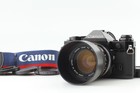
The Canon AL-1 was a 35mm film SLR camera introduced by Canon in 1982. It was designed to be an advanced, automatic camera that was easy to use, while still offering many manual controls.

Targeting users who had difficulty focusing through the viewfinder, the Canon AL-1 featured an electronic focus-assist system besides aperture-priority AE.

The system searches for the peak of the subject’s image contrast obtained by three linear CCD arrays. The bottom of the viewfinder has arrows indicating the direction to turn the focusing ring to achieve focus. When focus is achieved, the in-focus mark between the two arrows lights.

The exposure is controlled by a TTL silicon photocell and aperture-priority AE with centerweighted averaging metering. All shutter speeds are electronically controlled and stepless. The camera is also compatible with all FD lenses which allowed photographers to use a wide variety of high-quality lenses..

Categories
1980's Canon

Canon AE-1 Program

Canon AE-1 Program
BrandCanon
Release Year1981
Release Price60,000 yen (~$550)
Lens MountFD Mount

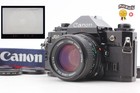
It was five years after the Canon AE-1 became a worldwide hit. Many users wanted the program AE mode that was featured in the Canon A-1. This mode set both the shutter speed and aperture automatically. The user just had to press the shutter button.

The Canon AE-1 Program camera was developed in response to the demand for program AE and to succeed the original Canon AE-1. The camera now had both shutter speed-priority AE and program AE modes. It also sported a palm grip like the Canon A-1. The camera was also compatible with the A-1’s Motor Drive MA. The viewfinder featured LEDs. It was quite an advanced camera.

To make Motor Drive MA compatible with the Canon AE-1 Program camera, it had three electrical contacts instead of only two which the original version had. Also, Power Winder A was converted into Power Winder A2 for higher performance.

Categories
1980's Canon

Canon New F-1

Canon new F-1
BrandCanon
Release Year1981
Release Price149,000 yen (~$1,350)
Lens MountFD Mount

Instead of being a next-generation successor to the Canon F-1, this camera was called the “New F-1,” and not the “F-2.” With the first Canon F-1 in 1971, Canon promised that the camera would remain unchanged for 10 years. This promise was fulfilled. During those ten years, there were remarkable advances in electronics, precision manufacturing, and optics. The successor to the top-of-the-line Canon F-1 had to incorporate the best electronic technology for better automation, versatility, and specifications.

Metering

For metering flexibility, it uses interchangeable focusing screens to change the metering pattern with a segmented metering element. For automation, system AE is incorporated for optimum operation. The camera’s basic controls are also the same as the old Canon F-1 so F-1 users can easily adapt to the updated camera.

The camera is a manual-exposure camera capable of TTL full-aperture metering and stopped-down metering with the included Eye-Level Finder FN. Aperture-priority AE is available by attaching the optional AE Finder FN. Also, shutter-priority mode is optionally available when using either AE Motor Drive FN or AE Power Winder FN.

Expanding system

The New F-1 is an expandable system. It consists of interchangeable viewfinders, focusing screens, motor drives, and alternate backs, all of which are specific to the New F-1. All other Canon components, such as the FD lens series, close up accessories (bellows, extension tubes, etc.), and Canon A and T Speedlights (except the 300TL) are also compatible with the system.

There are two different motorized film advance units in the New F-1 system: the AE Power Winder FN, and the AE Motor Drive FN. The AE Power Winder FN allows up to 2 frames per second (frame/s) in continuous mode, and the AE Motor Drive allows up to 5 frame/s in high-speed mode and 3.5 frame/s in low-speed mode. Both units also have single-exposure mode, where only a single frame is exposed when the shutter release is held down. Both units also have a second shutter release for vertical format shooting, and a subtractive frame counter. Only the AE Motor Drive FN has a motorized film rewind (therefore when using the AE Power Winder FN it is not necessary to remove the Rewind Coupler cover from the bottom of the camera).